
Office Space for Lease in Miami: Tenant & Landlord Insights
Published · Updated · 8 min read
Office space for lease in Miami offers tenants diverse options ranging from Class A towers in Brickell's financial district to boutique office buildings in Coral Gables and creative spaces in Wynwood. Understanding submarket dynamics, lease structures, and negotiation strategies helps both tenants secure optimal terms and landlords maximize occupancy and rental income.
Miami Office Market Overview for Tenants
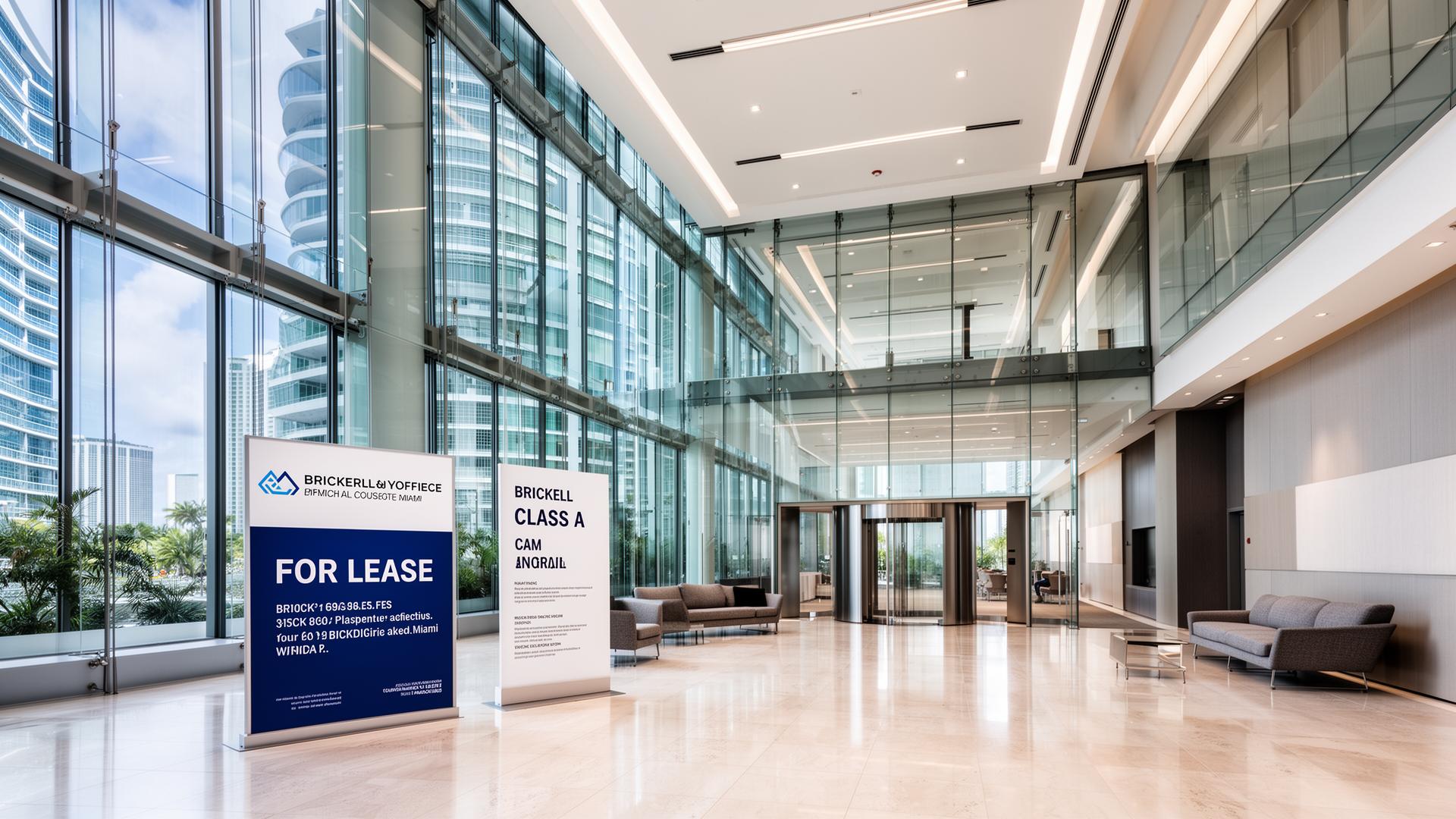
Miami's office market offers distinct submarket options for tenants seeking office space for lease:
Brickell — Financial District:
- Class A asking rents vary by building and lease terms; compare current listings and proposals.
- Best for: Financial services, legal, corporate headquarters, technology
- Amenities: Premium lobbies, fitness, dining, transit access
Coral Gables — City Beautiful:
- Class A asking rents vary by building and lease terms; compare current listings and proposals.
- Best for: International business, professional services, healthcare
- Amenities: Walkable downtown, restaurants, Mediterranean architecture
- Class A asking rents vary by building and lease terms; compare current listings and proposals.
- Best for: Government, legal, media, non-profit
- Amenities: Courthouse proximity, Metromover access, waterfront
Doral:
- Class A asking rents vary by building and lease terms; compare current listings and proposals.
- Best for: Latin American operations, logistics management, suburban corporate
- Amenities: MIA proximity, highway access, newer construction
How to Search for Office Space in Miami
A systematic search process helps tenants identify options within their budget and requirements:
Step 1: Define requirements
- Square footage needs (current and projected growth)
- Budget per square foot (including operating expenses)
- Location requirements (submarket, proximity to clients, transit)
- Term requirements (3, 5, 7, or 10+ years)
- Special needs (private offices vs. open plan, conference facilities, parking)
Step 2: Engage tenant representation
- Hire a tenant representative broker; fees are negotiated based on scope and set out in a written agreement
- Broker conducts market analysis and identifies candidate buildings
Step 3: Tour and evaluate
- Tour 5–10 shortlisted properties
- Evaluate each against requirements scorecard
- Request proposals from top 2–3 candidates
Step 4: Negotiate and execute
- Submit LOI (Letter of Intent) to preferred building
- Negotiate lease terms with broker guidance
- Execute lease and begin buildout planning
For expert guidance, contact Supreme CRE's office leasing team.
Office Lease Economics: Understanding Total Occupancy Cost
Definition: Total occupancy cost encompasses all expenses associated with leasing office space, including base rent, operating expenses, utilities, parking, and tenant improvement amortization.
Occupancy cost components:
- Base rent: Contractual rent per square foot
- Operating expenses: Taxes, insurance, CAM (passed through in most lease structures)
- Electricity: Separately metered or included in gross rent
- Parking: Fees vary by location and lease terms
- Effective rent: Base rent adjusted for TI amortization and free rent (actual cost to landlord)
Effective rent calculation example:
- Base rent: $50/SF
- TI allowance: $50/SF (amortized over 7-year term = $7.14/SF/year)
- Free rent: 7 months (amortized = $4.17/SF/year)
- Effective rent: $50 – $7.14 – $4.17 = $38.69/SF (landlord's effective income)
Comparing effective rents across buildings provides the most accurate cost comparison for tenants. This metric is also critical for commercial property valuation.
Landlord Strategies for Office Leasing in Miami
Miami landlords should implement strategic leasing approaches to maximize occupancy and rental income:
Leasing velocity strategies:
- Spec suite program: Build out 2–4 move-in-ready suites for small tenants (1,000–3,000 SF) who can't wait for construction
- Competitive TI packages: Match or exceed market TI allowances to attract quality tenants
- Broker incentives: Offer competitive commissions and bonuses for large lease transactions
- Building amenities: Invest in fitness, conferencing, outdoor spaces to differentiate from competitors
- Flexible term options: Offer 3-year options alongside traditional 5–7 year terms to capture startups and project-based tenants
Retention strategies:
- Begin renewal discussions 18+ months before expiration
- Offer early renewal incentives (TI refresh, reduced escalations)
- Address tenant maintenance requests promptly to maintain satisfaction
- Host tenant appreciation events and communication programs
Post-Pandemic Office Trends in Miami
Miami's office market has adapted to post-pandemic workplace trends differently than many major metros:
Trends shaping Miami office demand:
- Return-to-office momentum: Miami employers are leading the nation in return-to-office policies, driving in-person space demand
- Hybrid accommodation: Buildings offering flexible configurations (hoteling, collaboration zones) attract hybrid-model tenants
- Health and wellness: Enhanced air filtration, touchless technology, and outdoor spaces are now standard expectations
- Right-sizing: Some tenants reducing footprint per employee but increasing quality of space
- Amenity expectations: Tenants expect hospitality-level common areas to attract employees back to office
Miami's office market has benefited from relocation demand that other cities have not experienced, creating net positive absorption even as some existing tenants adjust space requirements. The Miami Downtown Development Authority tracks tenant relocations and office market activity, while the Miami-Dade County Economic Development department reports continued corporate migration trends supporting demand.
Buildout and Move-In Planning
After executing a lease, tenants must plan and execute their office buildout efficiently:
Buildout timeline planning:
- Space planning and design: 2–4 weeks
- Permitting: 2–6 weeks in Miami-Dade
- Construction (basic renovation): 6–10 weeks
- Construction (full buildout): 10–16 weeks
- Furniture installation and IT setup: 1–2 weeks
Timeline: Depends on design, permitting and construction scope; build contingency into the schedule.
Budget planning: Request written estimates for space planning and architecture, construction, furniture and fixtures, and technology infrastructure. Costs vary widely by scope, finish level and contractor.
Landlord TI allowances may cover a portion of these costs. Any amount exceeding the TI allowance is the tenant's responsibility.
Subletting and Assignment of Office Leases
Business changes may require tenants to sublet or assign their office lease. Understanding your rights and options is important:
Subletting:
- Tenant remains liable under the original lease
- Subtenant pays rent to the original tenant
- Most leases require landlord consent (not to be unreasonably withheld)
- Sublease terms cannot exceed the original lease
- Profit-sharing provisions may require splitting sublease profits with landlord
Assignment:
- Original tenant transfers all rights and obligations to a new tenant
- Original tenant may or may not be released from liability
- Landlord typically has approval rights over the assignee
- Landlord may have recapture rights to take back the space
Negotiating favorable assignment and subletting provisions at lease signing—before you need them—provides critical flexibility for business changes. See lease negotiation strategies.
Supreme CRE: Office Leasing Advisory in Miami
Supreme Capital Commercial Real Estate Miami provides comprehensive office leasing services for tenants and landlords across Miami-Dade:
For tenants:
- Requirement analysis and market research
- Property identification and tour coordination
- Lease negotiation and term optimization
- Buildout management and move-in coordination
For landlords:
- Leasing strategy and market positioning
- Tenant sourcing and qualification
- Lease negotiation and execution
- Retention advisory and renewal management
Explore available commercial real estate for lease in Miami or contact our team for personalized advisory.
Related Resources
Frequently Asked Questions
How much does office space cost in Miami?
Class A office rents vary by location, building quality, and lease terms; request current quotes for comparable spaces. Operating expenses depend on building class and lease structure.
When comparing buildings, focus on total occupancy cost (base rent + operating expenses + parking) rather than base rent alone. For example, a hypothetical $50/SF gross lease in Coral Gables may be more cost-effective than a $42/SF modified gross lease in Downtown once pass-through expenses and parking costs are included.
What size office do I need?
General planning standard is 150–250 SF per employee for traditional private office layouts and 100–150 SF per employee for open-plan configurations. Account for conference rooms, kitchen/breakroom, server rooms, reception areas, and circulation space in your total square footage calculation.
Consider projected growth when sizing your office—a 5-year lease commitment should accommodate your anticipated headcount growth through the lease term. Alternatively, negotiate expansion rights (ROFO or ROFR) for adjacent space to provide growth flexibility without over-leasing initially.
How long does it take to find and move into office space?
Plan 6–12 months total: 2–4 months for market search and lease negotiation, plus 3–6 months for space design, permitting, construction, and move-in. Spec suites or sublease opportunities with existing furniture can reduce the timeline to 2–3 months for tenants needing immediate occupancy.
In competitive submarkets like Brickell where Class A availability is limited, starting the search process early is critical. Engaging a tenant representative broker 9–12 months before your target move date provides the widest range of options and the strongest negotiation position.
Is tenant representation really free?
Fees are negotiated, depend on the scope of representation, and are set out in a written agreement. The agreement should specify who pays the tenant representative.
Representation can help tenants evaluate lease terms and navigate negotiations. Tenants who negotiate without representation may overlook opportunities to negotiate rent, TI allowances, and protective clauses.
What is the difference between usable and rentable square footage?
Usable SF is the actual space within your walls—the area you exclusively occupy. Rentable SF includes a pro-rata share of common areas (lobbies, corridors, restrooms, mechanical rooms). The difference is the 'load factor,' typically 12–18% for multi-tenant office buildings.
You pay rent on rentable square feet, not usable. A 5,000 RSF office with a 15% load factor provides approximately 4,250 usable SF. Comparing buildings on a usable SF basis provides the most accurate cost per actual workspace comparison, especially when load factors vary significantly between properties.
Can I sublease my office if I need to downsize?
Most commercial leases permit subletting with landlord consent, which cannot be unreasonably withheld under standard lease provisions. Review your sublease provisions carefully before signing your primary lease—some leases include recapture rights allowing the landlord to take back space you attempt to sublease.
Sublease rents depend on competing space, property condition, remaining lease term, and comparable offerings. Profit-sharing provisions in your lease may require splitting any sublease premium with the landlord. Having favorable sublease provisions in your original lease provides critical flexibility for business changes.